Friday, 5 October 2018

Dariush Shayegan (1935-2018): The real initiator of the Dialogue of Civilizations

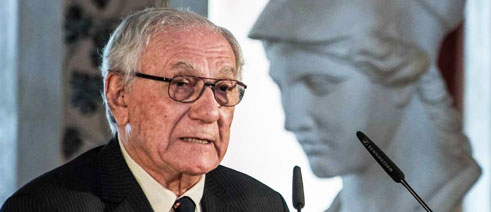
In 2000, the then president of the  Islamic Republic of Iran, Mohammad Khatami, surprised friend and foe by launching the Dialogue of Civilizations initiative, when addressing the UN's General Assembly. Clearly intended as a counter narrative to the 'Clash of Civilizations' Thesis which had by then begun to dominate the discourse on post-Cold War world order, its roots can actually be traced to another Iranian, who passed away on 22 March 2018.
Dariush Shayegan
The philosopher Dariush Shayegan, of mixed Persian and Georgian parentage and educated at a British boarding school, before switching to a Francophone university education in philosophy, Sanskrit and Asian religions, brought with him the cosmopolitan disposition and intellectual outlook to explore the avenue of intercivilizational dialogue in late 1970s-Iran. When this trajectory was cut short by the revolution of 1979 and subsequent establishment of the Islamic republic, Shayegan returned to Paris to continue researching and teaching philosophy and Asian religions in self-imposed exile, until again moving back to Iran in 1991. As observed by Stefan Weidner in his obituary of Shayegan:

His thinking was worlds apart from the fashionable, post-colonial theory that rejects the cultural and religious depths of colonised societies. [...] Paradoxically, it was in the West itself – where the question as to the role of tradition and spirituality in the face of materialism and secularism had been posed at a much earlier stage – that Shayegan found the best answers. 


Click here to read the full obituary.

Click on the image to check this book

Sunday, 26 November 2017

The Middle East is not the place to learn about Islam today: Jasser Auda


The Canadian-Egyptian scholar Jasser Auda must have turned quite a few heads with his statement that Muslims from across the world should not look to the Middle East for knowledge about Islam and certainly not send students there for a religious education:

We need to stop the trend of sending people to the Arab world, which is at a really low historical point these days, to learn about Islam 
He made these remarks at a roundtable discussion entitled "Reclaiming the Centre: The Role of Religion in a Multi-Racial Society", organised by the Centre for Nation-Building Studies at Institut Darul  Ehsan in Malaysia.

Auda is one of the leading proponents of so-called "Maqasidi thinking", a strand of contemporary Muslim thought advocating a reinterpretation of Islamic law by returning to its most fundamental philosophical underpinnings encapsulated in a subfield of traditional Islamic legal learning known as the Maqasid al-Shari'a, generally translated as 'Higher Objectives of Islamic Law'.

With a dual academic background in computer sciences and religious studies, complemented with many years of participating in study circles dispensing traditional Islam learning at Al-Azhar in Cairo, Auda first made a name for himself with a book entitled Maqasid al-Shariah as Philosophy of Law: A Systems Approach. For a while he was associated with the Research Center for Islamic Legislation and Ethics (CILE) in Doha, Qatar. He now heads the Maqasid Institute Global, a think tank registered in the UK, USA, Malaysia and Indonesia. 

While touring the world to give lectures and talks, or take part in panels, roundtable discussions and other forums, Auda's ideas find particularly receptive audiences in Southeast Asia: Aside from appearing in Arabic and English, his writings have also been translated in Malay and Bahasa Indonesia. It seems that it is because of his recognition of the importance of embedding Islamic doctrine in the respective cultural settings of different parts of the Muslim world that his thinking has traction in that particular region.


Friday, 10 November 2017

Cultural distinctiveness is no excuse for rejecting universal human rights standards

Morris Ayek
In a recent contribution to the Qantara website, Syrian writer Morris Ayek rejects the idea that Muslim countries have a right to make reservations on grounds of their 'cultural distinctiveness' regarding the applicability of the UN Declaration on Human Rights and other instruments of international law that have been derived from it. With his uncompromising defence of the validity of universal human rights standards, he joins the ranks of other Muslim intellectuals, such as  the legal scholars Abdullahi an-Na'im (cf. also this earlier post on this blog) and Khaled Abou El Fadl. Both would agree with Ayek's observation that:

Abdullahi an-Na'im

Regardless of the culture from which they emerge, universal values apply to all. For example, the concept of universal human rights is universally applicable, even though it has its roots in Western civilisation.

Khaled Abou El Fadl
Click here to read Ayek's article in full.The article also contains a long clip of a lecture by the Iranian philosopher Abdolkarim Soroush on 'Reason, Freedom and Democracy' -- at the same the title of one of his best known books).

Friday, 28 July 2017

The safest place for a Muslim is in a secular state

Abdullahi Ahmad an-Na'im
This is just one provocative statement by the Sudanese-born, but US-based, scholar Abdullahi Ahmad an-Na'im (1946). Trained as a jurist, he is also a follower of the late Mahmoud Muhammad Taha (1909-1985), whose controversial interpretation of the Qur'an led to his execution at the hands of one of Sudan's Islamist regimes.  Combining his legal learning and induction in the Sufi-inspired thinking of Taha, Abdullahi n-Na'im is considered one of the most prominent voices from the Muslim world advocating adherence to universal human rights standards and an outspoken proponent of a careful distinction between things political and religious.

In a recent interview with Germany's Qantara website, he elaborated on these points once again:
State and religion should be clearly separated. For me, as a Muslim, I need the state to be secular so that I can practice Islam through conviction and choice. The need of the state to be secular derives from an Islamic point of view; it has nothing to do with the European Enlightenment. The state has nothing to do with my being a believer or an atheist.[...] 
The concept of an Islamic state is a post-colonial concept that combines a European idea of the nation state and the idea of Muslim self-determination in terms of Islamic identity. We cannot really claim that everything that is going on around the world is due to the Enlightenment or the European idea of secularism!  
As to the role of Islamic law, generally referred to as 'Sharia', an-Na'im explains:
Sharia consists of the whole normative system of Islam founded in the Koran, the Sunna and the hadith, or tradition of the Prophet. So as such, it is not possible even in a secular state to deny Muslims the right to turn to Sharia to answer questions such as how to pray or how to fast.
Yet, at the same time:
Sharia cannot be enforced by the state anywhere. There is absolutely no possibility to enact Sharia as a law of the state whether it be in a so-called "Muslim majority country" or a tiny Muslim minority anywhere. The nature of Sharia defies codification. It is about the interpretation that people choose through their own conviction.
Being a jurist trained in 'secular' law and an academic teaching at Emory University in Atlanta, Georgia, it is tempting to consider an-Na'im's views as having been shaped by western legal thinking. However that is not the case. Much of it is grounded in the influence exercised by an-Na'im's spiritual-intellectual mentor, Mahmoud Muhammad Taha and his contrarian reading of the Qur'an. An-Na'im translated Taha's book on the subject into English, and it is was published under the title The Second Message of Islam. Here Taha argues that -- in contrast to conventional Muslim interpretations -- the Meccan chapters form the core of Islam's ethical outlook, while the Medinan chapters with their extensive legal excursions are in fact no more than a pedagogy to prepare the believers for becoming true Muslims.

True to Taha's work as an independence fighter and founder of the Republican Brotherhood movement, an-Na'im makes a case for 'indigenous self-liberation from colonisation', an effort that is not just political, but also epistemological:
 ...the hearts and minds of Muslims continue to be colonised by European epistemology and philosophy, by European ideas of administration of the state despite the fact that nominally, they have been independent for decades. Colonialism is not just simply a military occupation, it is a state of mind of both the coloniser and the colonised.
But that does not mean an-Na'im rejects all external intellectual influences 'from any other culture whether European or North American or otherwise'. However, in response to calls for an Islamic 'Reformation' or 'Muslim Luther', an-Na'im cautions against simplistic parallels and essentialist interpretations:
The actual history of the European Reformation was much more complex than just a German priest nailing some demands on the door of a church. Transformative movements take a long time and they are often a sort of intergenerational consensus that evolves over many generations in many different parts of the region. 
 For the whole interview click here


Tuesday, 13 December 2016

A leading Syrian exilic intellectual: Sadiq Jalal al-Azm (1934-2016)

Image result for sadiq al-azm

Syrian philosopher Sadiq Jalal al-Azm passed away in Berlin on Sunday, 11 December 2016. Al-Azm had already been living in German exile before civil war erupted in his homeland in the wake of the 2011 Arab Spring.

Although working mainly as an academic philosopher, Sadiq al-Azm also spoke and wrote about politics. Member of the prominent Damascene al-Azm family, which has produced generations of scholars and influential political figures, al-Azm positioned himself on the left and became an outspoken critic of the Assad government, when it became clear in 2000 that Hafiz al-Assad’s family and his wider Alawi clan were turning a military regime into a hereditary dynasty. For that reason, he also became one of the signatories of the 2005 ‘Damascus Declaration’, and later decided to join the Committee for the Revival of Civil Society’.

Although mainly regarded as a representative of the political left, Al-Azm has also written perceptively about religion and engaged critically with the challenge of Orientalism by peer such as Edward Said. This also forms the wider context for his decision to throw his intellectual weight behind opposition to the Assad regime that had its origins in the mosque. In an interview he gave in 2013, he explained that he did not regard this as giving up his advocacy of secularisation or his Marxist convictions. He still finds Marx’s classical analysis convincing, but believes that its interpretation and implementation along the lines of Franz Fanon are more relevant to a country like Syria. This is also the reason for his sympathy for the Catholic Liberation Theologies emerging in Latin America and even for the Iranian Revolution of 1979, which also included a very significant leftist component until its hijacking by the Islamists, which turned Iran into a ‘Mollahcracy’.

Al-Azm has always cautioned against having exaggerated expectations of what revolutions can accomplish. Structural changes to cultures are difficult to achieve and are the outcome of slow socially cumulative historical processes. In this regard, he pointed at argumentations put forward by other Syrian intellectuals like Jamil Saliba, Anton Makdisi and Tayyib Tayzini, as well as progressive thinkers from elsewhere, including his fellow philosopher Muhammad Abid al-Jabri and the historian Abdullah Laroui from Morocco, and the Egyptians Fouad Zakariyya and Nasr Hamid Abu Zayd.
As to the ideological dimensions for effecting drastic changes to a culture and society, al-Azm stresses that the key to success lies in secularisation and the creation of civil society, that is to say creating a sense of citizenship that overrides religiously-inspired one-dimensional identities.

A useful overview of the various stages of al-Azm’s intellectual life can be found here.

For some of  al-Azm's publications, click on the widget below: